
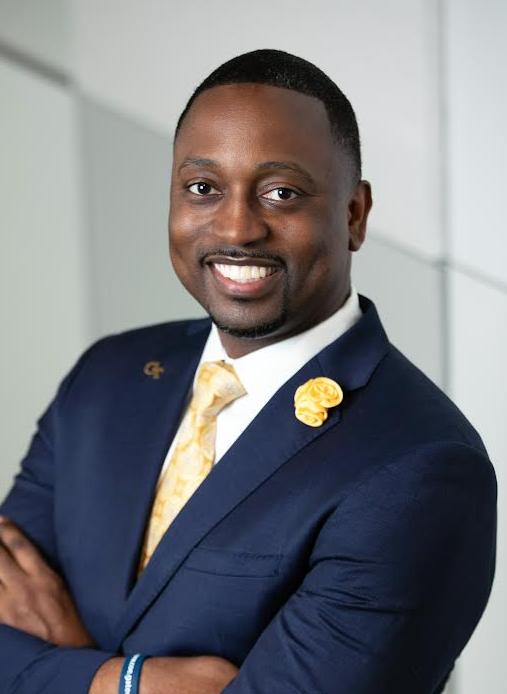
Associate Dean for Outreach and Engagement and
Senior Lecturer

Education
- M.Div (2012), Columbia Theological Seminary
- Ph.D. Industrial & Operations Engineering (2009), University of Michigan - Ann Arbor
- M.S. Industrial & Operations Engineering (2004), University of Michigan - Ann Arbor
- B.S. Industrial & Systems Engineering (Summa Cum Laude) (2002), Georgia Institute of Technology
About
Dr. Damon P. Williams is the inaugural Associate Dean for Outreach and Engagement within the College of Engineering (CoE) at the Georgia Institute of Technology (Georgia Tech). A distinguished alumnus of Georgia Tech, Dr. Williams began his academic career as a faculty member in the H. Milton Stewart School of Industrial and Systems Engineering (ISyE), where he lectured in applied probability and operations analysis. His research interests center on the mathematical modeling of stochastic processes and their applications in reducing variability within engineering systems.
Dr. Williams is an award-winning educator known for his ability to translate abstract theoretical concepts into real-world engineering applications, a skill that has earned him widespread recognition among students and colleagues alike. His teaching of foundational courses, particularly ISyE 2027: Introduction to Probability, a gateway course for the ISyE major, consistently attracts high enrollment and maintains a waitlist, reflecting his reputation as an effective and engaging instructor.
In 2020, Dr. Williams extended his impact beyond the classroom by founding and serving as the inaugural director of the Center for Academics, Success, and Engagement (CASE). The center supports the holistic development of the ISyE community through targeted programs and initiatives, including:
- Doctoral Pathways: Developing a track for ISyE doctoral students within the NSF-funded Tech to Teaching program, helping bridge the gap between academic research and teaching excellence.
- MentIE Mentoring: Facilitating connections between current students and ISyE alumni to provide mentorship in professional development, team dynamics, and career planning.
- Tutoring Services: Establishing a dedicated tutoring center to support undergraduate students within ISyE.
- Faculty Mentorship: Offering guidance to faculty on effective pedagogical strategies and techniques for teaching complex material.
- Staff Development (SOAR): Launching the Staff Opportunities to Accelerate Readiness (SOAR) program, which promotes the professional growth of administrative and support staff.
Dr. Williams’s ability to create and scale innovative initiatives led to his promotion in 2022 as the inaugural Associate Dean of Outreach and Engagement. In this role, he leads strategic initiatives aimed at fostering collaborations between the college and external stakeholders, including industry partners, alumni, K-12 schools, and the broader community. His outreach efforts have enhanced strengthened the college’s national and global reputation.
Dr. Williams’s leadership has been instrumental in the development of signature programs within the CoE, including:
- SOAR Expansion: Scaling the professional development program from ISyE to staff across the entire College of Engineering.
- Keep It In The Family Day: Hosting an engineering recruitment day that introduces children of CoE employees to engineering disciplines and the academic pathways necessary for admission.
- Engineering Student Ambassadors: Overseeing the student-driven outreach initiative within the Dean’s office, where ambassadors provide prospective students with insights into the CoE experience.
- STEM ATL: Partnering with STEM Global Action to deliver immersive, hands-on engineering experiences for K-12 students in the Atlanta area.
- Alumni Engagement Incubator: Designing events and opportunities to connect alumni with current students, fostering mentorship, career guidance, and philanthropic engagement.
In addition to these initiatives, Dr. Williams manages several critical departments within the College of Engineering. His work in these areas supports the college’s mission of student success by honoring that students are our top priority.
A native of Ellicott City, Maryland, Dr. Williams earned his Bachelor of Science in Industrial and Systems Engineering, summa cum laude, from Georgia Tech in 2002. He pursued his graduate studies at the University of Michigan, earning both his Master of Science and Ph.D. in Industrial and Operations Engineering.
Beyond his professional accomplishments, Dr. Williams takes pride in his family, which he regards as his most meaningful achievement. He is the devoted husband of the Rev. Dr. Khalia J. Williams, Associate Dean of Worship and Spiritual Formation and Associate Professor of Worship at Emory University’s Candler School of Theology. Together, they are the proud parents of two sons.
Teaching
I teach because I believe engineering is, at its core, a human endeavor: we use rigorous thinking to improve lives. That belief shapes my pedagogy and my responsibility as an instructor. My goal is not simply to “cover” content, but to build a learning environment where every student can develop durable understanding, confidence, and professional identity—especially in courses that students often experience as gatekeepers. In my classroom, excellence and inclusion are not competing values. They are mutually reinforcing commitments that create the conditions for all learners to thrive. I design my courses around a simple premise: students learn engineering by doing engineering. That means class time is not dominated by uninterrupted lecture. Instead, I structure learning as a cycle of preparation, active engagement, feedback, and reflection. I use short explanations to introduce core concepts, then shift quickly to structured practice—think-pair-share, annotated problem walkthroughs, quick polls, mini design challenges, or “explain your reasoning” prompts that reveal what students understand and where misconceptions hide. This approach aligns with strong evidence that active learning improves student learning and can particularly benefit students from backgrounds underrepresented in STEM. In practical terms, I aim for students to leave each class having used the idea we studied: applying a model, interpreting data, debugging a solution, or communicating a design tradeoff. When students experience repeated, low-stakes opportunities to practice thinking like engineers—with coaching rather than judgment—they grow. They also begin to trust the learning process and their place in it.
A thriving learning environment is not accidental; it is engineered. I begin with explicit learning outcomes and build backward to align instruction, practice, and assessment. The syllabus and course site are not just administrative documents—they are learning tools, designed for clarity, transparency, and student success. Georgia Tech’s Center for Teaching and Learning emphasizes syllabus design and course policies that support effective learning environments, and I take that guidance seriously. Alignment also shapes assessment. I use a mix of formative and summative assessments to measure what matters: conceptual understanding, problem-solving process, and the ability to communicate decisions with evidence. I incorporate frequent checks for understanding (short quizzes, reflective prompts, “one-minute papers,” or quick problem sets) so students can calibrate their learning early rather than discovering gaps at the exam. In engineering education, we often reward correct answers more than correct thinking. My assessments are built to honor both. I treat participation as a pedagogical practice: the intentional design of experiences that communicate, repeatedly, “You can succeed here—and you do not have to succeed alone.” I do this through norms and structures that protect dignity while inviting intellectual risk. I establish expectations for respectful collaboration, teach students how to give and receive feedback, and use group work strategically so that it becomes a tool for learning rather than a mechanism for inequity.
I also practice “transparent teaching”: I explain why we are using a particular method, how students should engage it, and what success looks like. When students understand the purpose behind active learning, they participate more fully and are more willing to persevere through productive struggle.
Accessibility is part of participation. I strive to provide multiple entry points into complex material—visuals, narratives, worked examples, and opportunities to practice with guidance. I encourage students to use office hours and peer learning spaces early, and I normalize help-seeking as a hallmark of professionalism. In engineering, where collaboration is the norm, learning in community should not be treated as weakness. My deepest aim is to develop engineers who can reason under uncertainty: define problems, make assumptions explicit, evaluate tradeoffs, and communicate with integrity. To support that goal, I emphasize sensemaking over memorization. When students are stuck, I do not rush to rescue them with answers. I coach them toward strategies: draw a diagram, test a boundary case, name what you know, identify what is missing, and choose a next step. Over time, students internalize these moves as habits of mind. I also connect concepts to authentic contexts—real datasets, contemporary engineering applications, or design constraints that mirror professional reality. Authenticity strengthens motivation and helps students see that the work is not arbitrary; it is preparation for real impact. When students recognize the relevance of what they are learning, they invest more deeply and persist longer.
I treat teaching as iterative design. I gather feedback through mid-semester check-ins, short anonymous prompts, and careful analysis of assessment patterns. If many students miss the same idea, I assume the learning environment needs adjustment—not that students “weren’t ready.” I refine pacing, add scaffolded practice, and develop targeted support materials (short videos, example banks, guided worksheets, or optional review sessions). This continuous improvement mindset mirrors the engineering process: observe, diagnose, prototype, test, and refine.Reflection is equally important for students. I build in brief metacognitive routines—exam wrappers, self-assessments, and goal-setting prompts—so students learn how they learn. When students can articulate what strategies helped and what did not, they become more autonomous, resilient learners.
I aspire to teach in a way that is rigorous, humane, and consequential. I want students to leave my classroom not only stronger in technical skill, but also more confident in their ability to learn hard things and contribute meaningfully. My teaching statement can be summarized in one commitment: I will design learning experiences where excellence is reachable through effort, support, and clear expectations—so that every student who enters willing to work can thrive.
I