
Georgia Tech's H. Milton Stewart School of Industrial and Systems Engineering (ISyE) is launching a new undergraduate concentration in Artificial Intelligence and Operations Research (AI/OR) in Decision-Making this fall, formalizing a comprehensive AI and machine learning curricula. The concentration brings together machine learning, optimization, online decision-making, and responsible AI into a structured pathway for students who want to specialize at the intersection of artificial intelligence and operations research; fields that have always been deeply connected and are increasingly inseparable in industry practice.
The concentration was developed under the leadership of A. Russell Chandler III Chair and Professor Guanghui (George) Lan, who served as the named lead on the proposal to the Institute Undergraduate Curriculum Committee, working with a group of ISyE faculty across the AI, optimization, and statistics areas. The other ISyE contributing faculty members include Ashwin Pananjady, Yao Xie, Katya Scheinberg, Johannes Milz, Joel Sokol, and Juba Ziani, whose collective expertise in optimization, machine learning, and statistical modeling shaped the curriculum.
The curriculum draws on a portfolio of seven undergraduate courses taught by ISyE faculty, spanning the mathematical and algorithmic foundations of modern AI. Among them is Foundations of AI for Decision Systems, developed and taught by Milz, an assistant professor, which opens the black box of large language models. Students learn what is actually happening inside the AI systems they use every day from tokenization and attention mechanisms to the training processes that shape model behavior. They will graduate able to explain why outputs vary, why models hallucinate, and when an AI response should be trusted. As Milz has observed, students who enter thinking of AI outputs as either right or wrong leave the course recognizing that hallucination is not a random error but a predictable consequence of how these systems work, a more durable form of AI literacy than any tool-based introduction could provide.
Foundations of Modern Data Science, taught by Pananjady, the Gerald D. McInvale Early Career Professor and assistant professor, takes a "looking under the hood" approach to data science — developing the probabilistic modeling, statistical inference, and optimization foundations that make modern data methods coherent. Students engage with everything from generative modeling and Bayesian inference to A/B testing and causal inference, learning to evaluate methods critically rather than apply them as black boxes.
The concentration also draws on Foundations and Applications of Machine Learning (ISYE 4600), developed by Xie, the Coca-Cola Foundation Chair and professor, and now taught by her and several other faculty. The course introduces senior undergraduates to the core methods of modern machine learning – supervised and unsupervised learning, classification, regression, neural networks, feature selection, and ensemble methods – with an emphasis on mathematical foundations, algorithmic understanding, and practical implementation.
Two additional courses launch alongside the concentration this fall: Responsible AI, taught by Ziani, an assistant professor, which grounds questions of fairness, accountability, and human-aware decision-making in the mathematical tools of machine learning and optimization; and Optimization Foundations for Machine Learning and AI, taught by Scheinberg, the Coca-Cola Foundation Chair and professor.
Together with existing courses on modern data science, machine learning, reinforcement learning, online learning, and advanced stochastic systems, the concentration prepares students to understand AI systems from the inside, evaluate their outputs critically, and deploy them responsibly in the complex operational settings where ISyE graduates work: supply chain, healthcare, manufacturing, finance services, and logistics.
The concentration's launch coincides with two new program-wide requirements for all BSIE students taking effect Fall 2026: a systems design requirement, ensuring every graduate has experience designing solutions at the systems level rather than optimizing components in isolation; and a human factors overlay, reflecting the growing centrality of human-AI interaction across every domain where ISyE graduates contribute.
"The methods that power modern AI from optimization, stochastic modeling, statistical inference to sequential decision-making are the methods ISyE has taught for decades," said Dima Nazzal, Associate Chair for Academic Administration. "What is new is the intentionality with which we are making that connection explicit, and the depth of preparation we are offering students who want to lead in AI-driven industries."
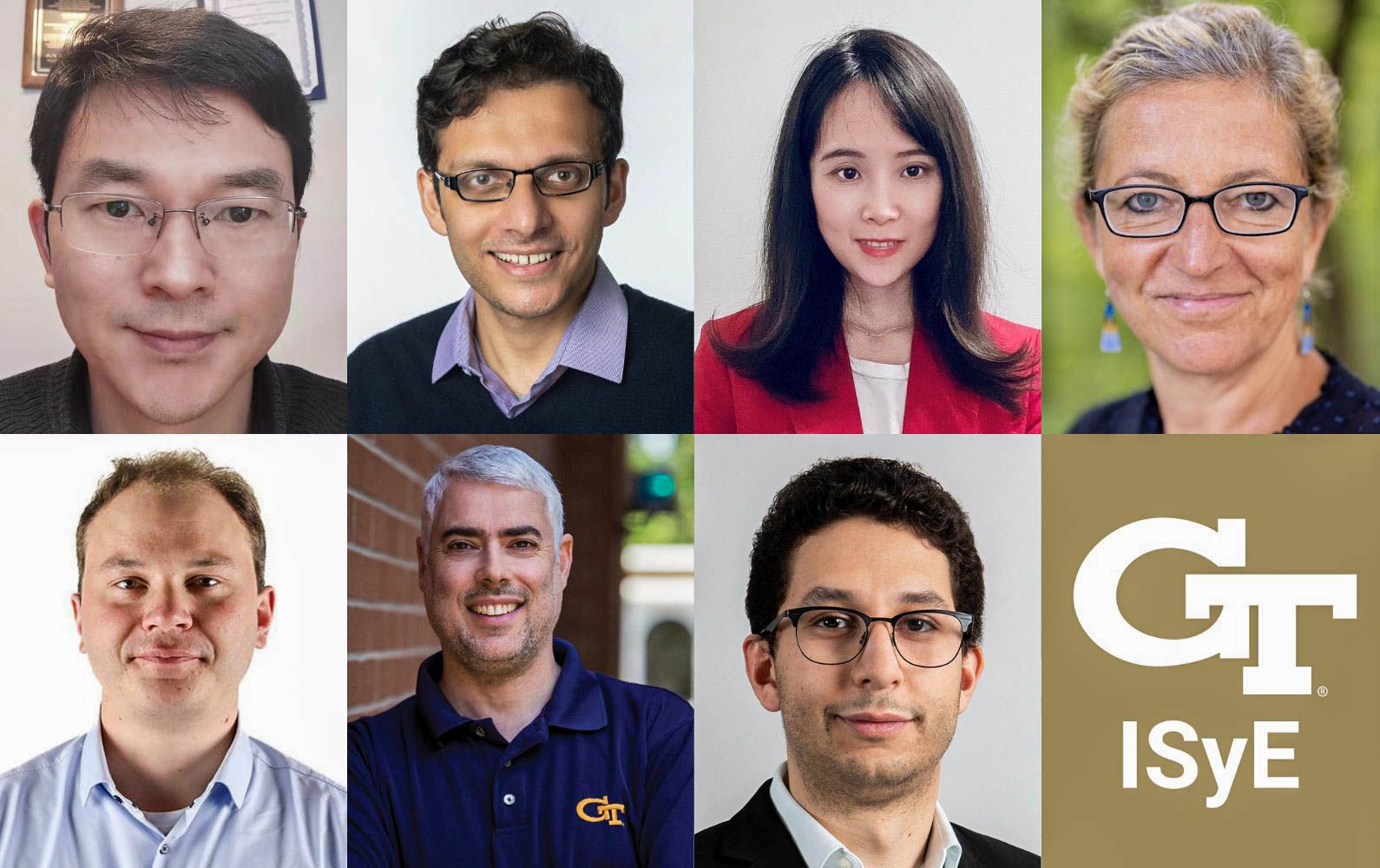
Pictured Left to Right: George Lan, Ashwin Pananjady, Yao Xie, Katya Scheinberg, Johannes Milz, Joel Sokol, and Juba Ziani