
This summer, eight undergraduate researchers are taking on big questions with even bigger potential. How can AI make public health information easier to understand? What causes financial systems to fail? How can computer chips stay cooler, and recommendation systems become fairer?
Through the H. Milton Stewart School of Industrial and Systems Engineering's (ISyE) Summer Undergraduate Research Scholars (SURS) program, these students are working toward answers to complex challenges like these. Over the course of 10 weeks, they work alongside faculty mentors, gaining hands-on research experience while developing new technical skills and contributing to research across a wide range of disciplines.
While their research spans AI for public health, urban design, sustainable transportation, semiconductor design, financial systems, optimization, time-series forecasting, and fairness in recommender systems, every project in the 2026 cohort begins with the same goal: using engineering and data-driven approaches to solve meaningful problems. Meet this year's scholars to learn what inspired their research, the questions they hope to answer, and the discoveries they aim to make throughout their summer projects.
Ze Yu Jiang (Georgia State University) – Advisor: Patrick Kastner
Project: Inverse Urban Design for Wind Comfort using Surrogate Models
Ze Yu is developing AI-powered tools that help urban planners quickly evaluate building designs and create more comfortable outdoor spaces for pedestrians. After spending more than two years researching urban design, he sees this project as the next step toward making the design process faster and more effective:
"Seeing as how we now have models that can quickly get accurate outputs, the next step would be to help designers quickly find designs that would produce outputs they are aiming for; then, we'd have an even more productive design process! That's where my motivation came for this research!”
Gary Mei (Georgia Institute of Technology) – Advisor: Souvik Dhara
Project: A Two-Channel Cascade Model of Bank Failure
Gary is studying how financial crises spread through banking networks to better understand what can lead to widespread economic instability. His longtime interest in finance sparked the idea behind his research:
"When my professor introduced me to random graphs, my first thought was to model financial events with random graphs. I eventually landed on modeling bank failures, and I realized that the current configuration didn't account for bank runs/fear, and that's what inspired my research."
Haili-Marie Cox (Georgia Institute of Technology) – Advisor: Xiaochen Xian
Project: Making Public Health Information More Accessible with Large Language Models
Haili-Marie is building AI-powered tools that make trusted public health information easier for people to find, understand, and engage with. For her, the project combines her interest in artificial intelligence with a desire to create tools that make a meaningful difference:
“I was drawn to this topic of research because I’m looking to build my skills in building tools that solve real-world problems. I’m excited to see how AI can help bridge the gap between public health information and the people who need it most, while also learning more about how users interact with AI-powered resources."
Kaitao Liao (Emory University) – Advisor: Enlu Zhou
Project: Generative Boltzmann Optimization via Conditional Diffusion Models for Black-Box Optimization
Kaitao is exploring how AI can improve optimization methods by generating better solutions to complex problems. He is excited by the opportunity to tackle challenging optimization problems while advancing emerging AI techniques:
“I chose this project because I'm interested in solving challenging high-dimensional and complex optimization problems. I'm excited to explore how the GBO-CD algorithm can be improved to make it more robust and effective on these difficult optimization tasks."
Jevon Twitty (Georgia Institute of Technology) – Advisor: Shihao Yang
Project: Capturing Shifting Temporal Dependencies with Tri-Region Fast Weights
Jevon is developing more efficient AI models that can better recognize patterns in time-series data across a variety of real-world applications. His interest in practical machine learning applications led him to explore new approaches to time-series forecasting:
"I personally enjoy working in time series because I think it's a very practical field with tangible applications across many domains ... My current project is focused on Tri-Region Fast-Weight Hypernetworks, and I'm excited to see if their inherent expressivity can prove effective in modeling complex inter-series dependencies in large-scale datasets with many channels."
Arsen Kozhabek (Georgia Institute of Technology) – Advisor: Johannes Milz
Project: Pyrova: Thermal-Aware Macro Placement Under Workload Uncertainty
Arsen is researching ways to optimize computer chip layouts, so they remain cool and efficient under changing workloads. This project gives him an opportunity to combine his interests in electrical engineering, chip design, and optimization:
"As an [electrical engineering] (EE) major, I was looking for a project at the intersection of EE and [ISyE]. I'm interested in chip design, and Dr. Milz has strong expertise in optimization, so we thought it'd be interesting to apply optimization to some part of the chip design flow — physical design felt like the most natural fit. I'm hoping to grow as a researcher and come out with a stronger foundation in both hardware and applied math.”
Zaid Baloch (Georgia State University) – Advisor: Srinivas Peeta
Project: Advancing Sustainable Travel in Smart Communities
Zaid is helping develop data-driven transportation solutions that improve mobility, accessibility, sustainability, and quality of life in smart communities. He sees the experience as a chance to apply technology to challenges that affect everyday life:
"I chose this project because I am interested in applying data and technology to solve real-world transportation challenges that can improve people's daily lives. Through this experience, I hope to strengthen my technical and research skills while gaining a deeper understanding of how data-driven solutions are designed, implemented, and evaluated in smart communities.”
Lauren Patterson (Emory University) – Advisor: Juba Ziani
Project: Feedback Loops and Fairness in Recommender Systems
Lauren is studying how recommendation systems can unintentionally create unfair outcomes and exploring ways to make online platforms more equitable for all users. Her curiosity about algorithms, privacy, and the ways digital platforms shape consumer behavior inspired her to pursue this research:
“This might be kind of nerdy, but I’ve had a bit of a hyperfixation on recommender systems, pricing algorithms, privacy, and how platforms influence people’s behavior ... [There are] concerns around platforms using behavioral data, like how often someone looks at an item, to personalize recommendations, ads, or even pricing ... A person might feel like they are making a normal shopping decision, but the platform may have already shaped the options, timing, framing, and price in front of them. [This is what inspired my research.]”
Interested in getting involved with undergraduate research at ISyE? To learn more about upcoming opportunities, faculty mentors, and student projects, visit the ISyE Undergraduate Research Portal.
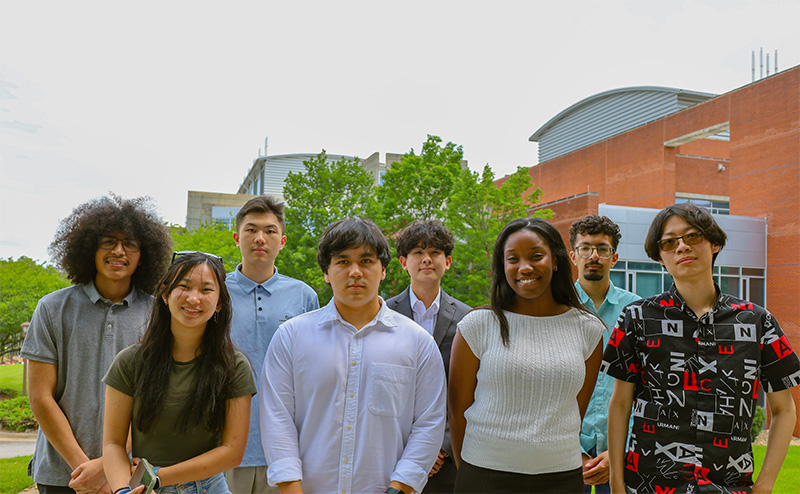
2026 Summer Undergraduate Research Scholars
For More Information Contact
Tiffany Ng,
Student Assistant