
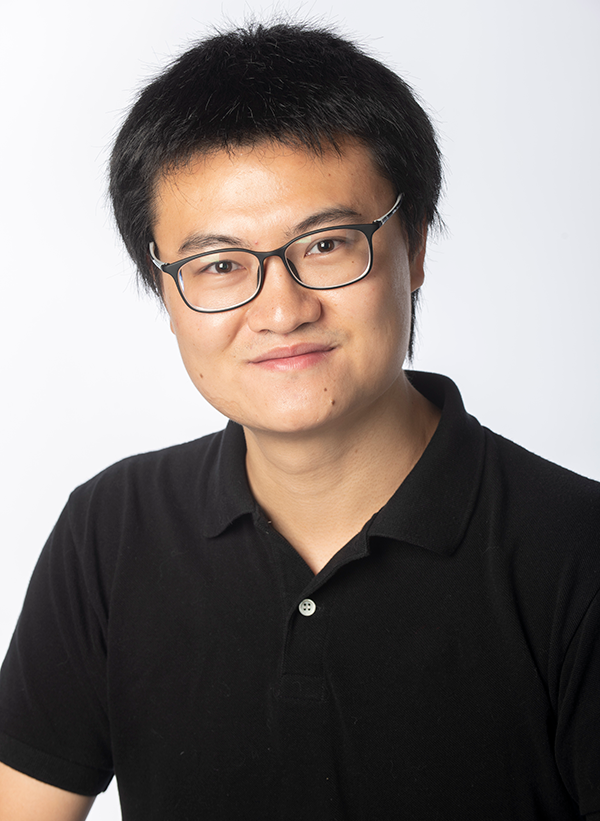
Harold E. Smalley Early Career Professor and
Assistant Professor

Education
- Ph.D. Statistics (2019), Harvard University
- A.M. Statistics (2016), Harvard University
- B.Sc. Actuarial Science (2014), University of Hong Kong
About
Shihao Yang is a Harold E. Smalley Early Career Professor and tenure-track Assistant Professor in the H. Milton Stewart School of Industrial and Systems Engineering at Georgia Tech, with specialty in statistics, data science, and machine learning.
Prior to joining ISyE, Shihao Yang received his Ph.D. in statistics from Harvard University in 2019, advised by Prof. Samuel Kou. He completed his post-doc training in 2020 with Prof. Isaac Kohane in the Department of Biomedical Informatics at Harvard Medical School.
Research
Dr. Yang's research focuses on time series analysis, developing both theory and methods at the intersection of statistical modeling and modern deep learning:
Physics-Informed Machine Learning for Dynamical Systems. Dr. Yang develops Gaussian process methods that embed the structure of ordinary differential equations directly into statistical inference. This line of work enables principled parameter estimation, uncertainty quantification, and change-point detection in dynamic systems from noisy and sparse data. Key contributions include the MAGI framework for ODE inference (PNAS 2021), extensions to PDE systems (SIAM/ASA JUQ 2024), and accompanying open-source software on CRAN and GitHub.
Attention Mechanisms and Transformers for Time Series. Dr. Yang's group designs transformer architectures tailored to the structure of time series data, bridging classical autoregressive models with modern attention mechanisms. Recent contributions include methods that align linear attention with VAR models, construct auxiliary time series as exogenous variables for multivariate forecasting, and develop zero-sum linear attention for efficient transformers. These works has been published at NeurIPS (Spotlight), ICML, and ICLR.
Applications in Infectious Disease Forecasting. These methodological advances are applied to real-time forecasting of influenza, COVID-19, dengue, and other infectious diseases, integrating internet search data, electronic health records, and epidemiological surveillance. Dr. Yang's forecasting models have been featured on the CDC FluSight website and covered by outlets including CNN, Voice of America, and Ars Technica.
Teaching
Dr. Yang teaches courses in regression, forecasting, and multivariate data analysis at both the undergraduate and graduate levels, including ISYE 4031 (Regression and Forecasting) and ISYE 7405 (Multivariate Data Analysis). He also developed a graduate special topics course on data-driven infectious disease prediction.
Representative Publications
Physics-Informed Machine Learning & Gaussian Processes
- S. Yang, S.W.K. Wong, and S.C. Kou, "Inference of dynamic systems from noisy and sparse data via manifold-constrained Gaussian processes," Proceedings of the National Academy of Sciences (2021).
- Z. Li, S. Yang, and C.F. Wu, "Parameter Inference via Nonlinear Partial Differential Equations Informed Gaussian Processes," SIAM/ASA Journal on Uncertainty Quantification, 12(3): 964–1004 (2024).
- S.W.K. Wong, S. Yang, and S.C. Kou, "MAGI: A Package for Inference of Dynamic Systems from Noisy and Sparse Data via Manifold-constrained Gaussian Processes," Journal of Statistical Software, 109: 1–47 (2024).
- Y. Sun and S. Yang, "Manifold-constrained Gaussian process inference for time-varying parameters in dynamic systems," Statistics and Computing, 33(6): 142 (2023).
Transformers & Attention Mechanisms for Time Series
- J. Lu and S. Yang, "HyperMLP: An Integrated Perspective for Sequence Modeling," ICML 2026.
- J. Lu and S. Yang, "Free Energy Mixer," ICLR 2026.
- J. Lu, X. Han, Y. Sun, V. Pati, Y. Kim, S. Somani, and S. Yang, "ZeroS: Zero-Sum Linear Attention for Efficient Transformer," NeurIPS 2025 Spotlight.
- J. Lu and S. Yang, "Linear Transformers as VAR Models: Aligning Autoregressive Attention Mechanisms with Autoregressive Forecasting," ICML 2025.
- J. Lu, X. Han, Y. Sun, and S. Yang, "WAVE: Weighted Autoregressive Varying Gate for Time Series Forecasting," ICML 2025.
- J. Lu, Y. Sun, and S. Yang, "In-context Time Series Predictor," ICLR 2025.
- J. Lu, X. Han, Y. Sun, and S. Yang, "CATS: Enhancing Multivariate Time Series Forecasting by Constructing Auxiliary Time Series as Exogenous Variables," ICML 2024.
- J. Lu, X. Han, and S. Yang, "ARM: Refining Multivariate Forecasting with Adaptive Temporal-Contextual Learning," ICLR 2024.
Infectious Disease Forecasting
- R. Garrido-Garcia, L. Clemente, A.G. Meyer, G. Dewey, S. Yang, and M. Santillana, "A real-time early warning system to anticipate respiratory disease outbreaks using transfer learning," Nature Communications, 17(1): 6599 (2026).
- S. Ma, S. Ning, and S. Yang, "Joint COVID-19 and Influenza Forecasts in the United States using Internet Search Information," Communications Medicine (Nature), 3: 39 (2023).
- S. Yang, M. Santillana, and S.C. Kou, "Accurate estimation of influenza epidemics using Google search data via ARGO," Proceedings of the National Academy of Sciences, 112(47) (2015).