
Nagi Gebraeel, Georgia Power Professor in the H. Milton Stewart School of Industrial and Systems Engineering at Georgia Tech, has received the 2026 Career Achievement Award from the Energy Systems Division of the Institute of Industrial and Systems Engineers (IISE). The award was presented at the 2026 IISE Annual Conference & Expo in Arlington, Texas.
The award recognizes division members who have made sustained and exceptional contributions to research and applications in energy systems, demonstrated through distinguished scholarly achievement. Gebraeel was honored for more than two decades of research advancing how energy systems are monitored, maintained, operated, and protected. His work has also been shaped by collaborations with major industrial partners and organizations, including Southern Company, GE, Siemens, Pratt & Whitney, and the Electric Power Research Institute (EPRI).
Much of Gebraeel’s work builds on his early contributions to Prognostics and Health Management. PHM is a field that uses sensor data and predictive analytics to assess asset condition, forecast degradation, and support operational decisions. In the energy sector, this research has developed along three connected directions: monitoring individual energy assets, optimizing power network operations and maintenance, and improving the security of increasingly digital energy systems.
Gebraeel’s research group developed predictive analytics methods for monitoring gas turbines, drawing in part on experimental capabilities at Georgia Tech’s Ben T. Zinn Combustion Laboratory, directed by Professor Tim Lieuwen and the START labs at Penn State University. His group also demonstrated that smart meters already deployed in homes can be used to monitor the health of transformers, at negligible additional cost, in collaboration with Georgia Tech’s Center for Distributed Energy, led by Professor Deepak Divan.
The second direction extends from individual assets to the broader power network. Gebraeel and his team developed optimization models that utilize real-time information about generator health to guide both operational and maintenance decisions. These models determine how generators should be dispatched and maintained while satisfying electricity demand and respecting the topology and transmission limits of the power network. His group also worked on scalable solutions that help translate these models from academic studies to large, practical power networks.
The third direction addresses power system cybersecurity, drawing on expert collaboration with Professor A.P. “Sakis” Meliopoulos of Georgia Tech’s School of Electrical and Computer Engineering and his Power Systems Control and Automation Laboratory. Gebraeel’s group developed methods to detect stealthy cyberattacks that falsify sensor readings, distinguish those attacks from ordinary equipment faults, and identify compromised regions of the network using only normal operating data. His group also developed a blockchain-based framework that allows utilities to jointly detect attacks across interconnected systems while preserving the privacy of each company’s operational data.
“This award reflects a journey shared with remarkable students, collaborators, and industry partners,” said Gebraeel. “I owe a special debt to Georgia Tech’s Strategic Energy Institute and to its director at the time, Tim Lieuwen, whose vision and support helped draw my research into data science and energy systems and opened the door to the partnerships that shaped this work.”
Gebraeel, who served as associate director of the Strategic Energy Institute from 2016 to 2021, continues to advance research in decentralized industrial intelligence, including federated learning methods that allow energy companies to develop privacy-preserving diagnostic models, as well as uncertainty-aware optimization models that remain robust under noisy data and feature uncertainty.
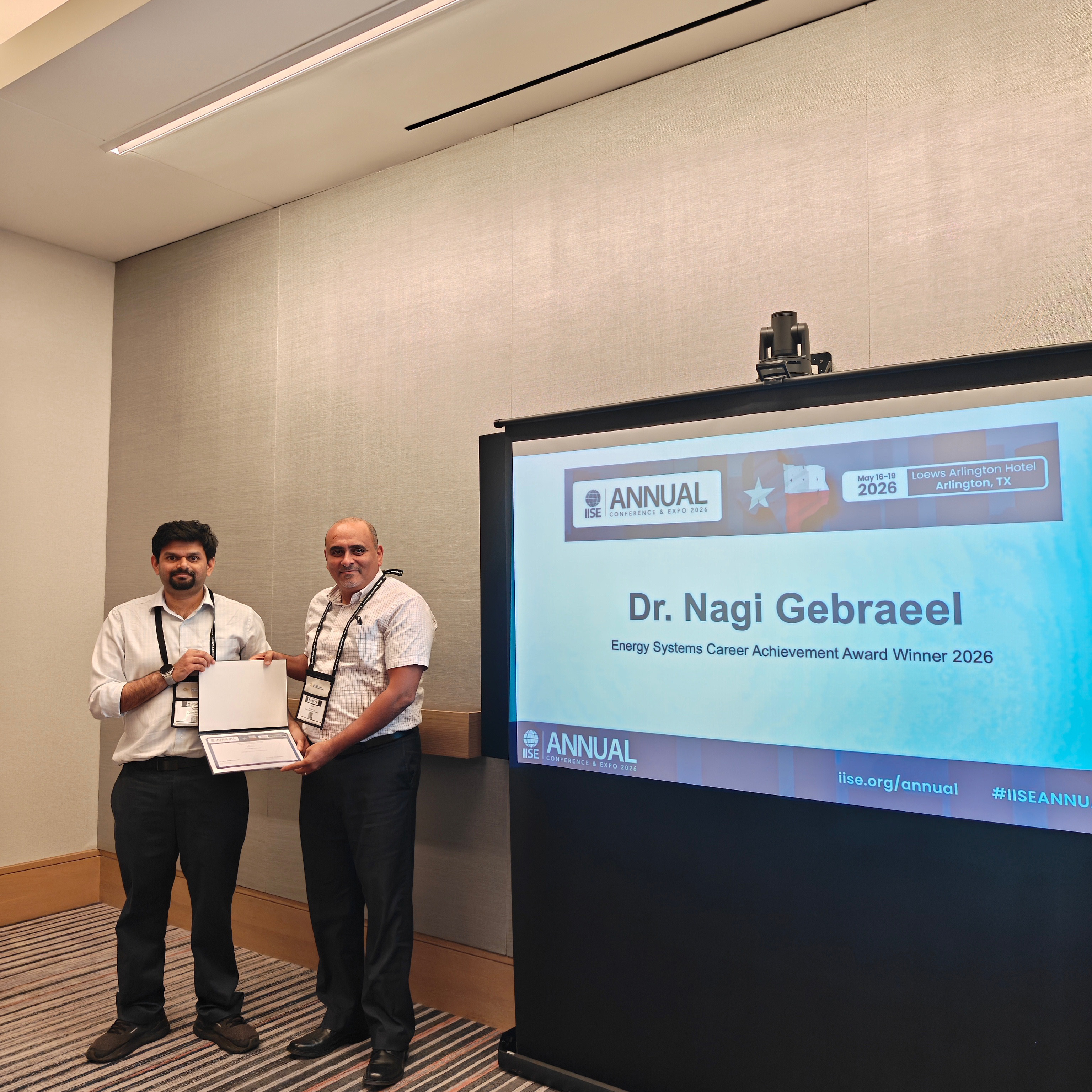
Professor Nagi Gebraeel receives the 2026 IISE Career Achievement Award