
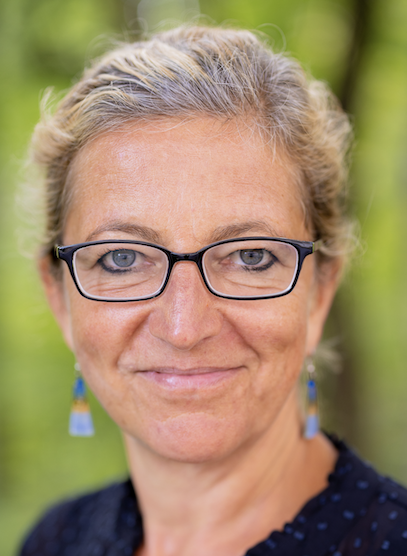
Coca-Cola Foundation Chair and
Professor
Education
- Ph.D. Operations Research (1997), Columbia University
- M.S. Operations Research (1994), Columbia University
- B.S.-M.S. Operations Research (1992), Lomonosov Moscow State University
About
Katya Scheinberg is a Coca-Cola Foundation Chair and Professor in the H. Milton Stewart School of Industrial and Systems Engineering at Georgia Tech. She is also a Gary C. Butler Family Faculty Fellow. Prior to joining Georgia Tech she was a professor in the School of Operations Research and Information Engineering (ORIE) faculty at Cornell University. She joined the ORIE faculty after serving as the Harvey E. Wagner Endowed Chair Professor at the Department of Industrial and Systems Engineering at Lehigh University. She was also a co-director of Lehigh Institute on Data, Intelligent Systems and Computation. Professor Scheinberg was born in Moscow, Russia, and earned her undergraduate degree in operations research from the Lomonosov Moscow State University in 1992 and then received her Ph.D. in operations research from Columbia in 1997. She was a research staff member at the IBM T.J. Watson Research Center for over a decade, where she worked on various applied and theoretical problems in optimization.
From July 2025 I serve as the Chair of the Mathematical Optimization Society and a co-editor of Mathematical Programming. Her past service includes Editor-in-Chief of the Mathematics of Operations Research, chair of SIAM Activity Group on Optimization. , Editor-in-Chief of SIAM-MOS Series on Optimization and an associate editor of SIOPT, Mathematical Programming and SIMODS as well as the editor of Optima, the MOS newsletter.
Her awards include, Lagrange Prize in Continuous Optimization (together with Andrew R. Conn and Luis N. Vicente), Farkas Prize from Informs Optimization Society, the Outstanding Simulation Publication award from Informs Simulation Society (jointly with Jose Blanchet, Coralia Cartis and Matt Menickelly) SIAM Fellow and Informs Fellow.
Her research is supported by grants from AFOSR, DARPA, NSF, ONR and Yahoo and Google.
Research
Professor Scheinberg’s main research areas are related to developing practical algorithms and their theoretical analysis for various problems in continuous optimization, such as convex optimization, derivative free optimization, machine learning, quadratic programming, etc. She published a book in 2009 titled, Introduction to Derivative Free Optimization, which is co-authored with Andrew R. Conn and Luis N. Vicente. Recently some of her research focuses on the analysis of probabilistic methods and stochastic optimization with a variety of applications in machine learning and reinforcement learning.
Teaching
Professor Scheinberg has taught undergraduate and graduate courses on a variety of topics, including Linear Algebra, Deterministic Optimization, Linear and Integer Programming, Derivative Free Optimization, Nonlinear Optimization and Optimization for Machine Learning.
Awards and Honors
- Sectional Lecture at the International Congress of Mathematicians
- SIAM Fellow
- Informs Fellow
- Outstanding Simulation Publications Award
- Farkas Prize, Informs Optimization Society
- Lagrange Prize in Continuous Optimization
Representative Publications
- Finite Difference Gradient Approximation: To Randomize or Not? INFORMS Journal on Computing, 2022.
- Global Convergence Rate Analysis of a Generic Line Search Algorithm with Noise. with Albert S Berahas and Liyuan Cao, SIAM J. Optim. 31(2): 1489-1518 (2021)
- High Probability Complexity Bounds for Adaptive Step Search Based on Stochastic Oracles with Billy Jin and Miaolan Xie, to appear in SIAM J. Optim, (conference version NeurIPS 2021: 9193-9203)
- A Theoretical and Empirical Comparison of Gradient Approximations in Derivative-Free Optimization, with Albert S Berahas, Liyuan Cao, and Krzysztof Choromanski, Found. Comput. Math. 22(2): 507-560 (2022).
- Optimal Generalized Decision Trees via Integer Programming, with O. Gunluk, M. Menickelly and J. Kalagnanam, J. Glob. Optim. 81(1): 233-260 (2021)
- A Stochastic Line Search Method with Expected Complexity Analysis, with Courtney Paquette, SIAM J. Optim. 30(1): 349-376 (2020)
- Adaptive Stochastic Optimization: A Framework for Analyzing Stochastic Optimization Algorithms, with Frank Curtis, IEEE Signal Process. Mag. 37(5): 32-42 (2020)
- Convergence Rate Analysis of a Stochastic Trust Region Method via Submartingales with Jose Blanchet, Coralia Cartis and Matt Menickelly, 2018.
- Stochastic Optimization Using a Trust-Region Method and Random Models, with R. Chen and M. Menickelly, Math. Program. 169(2): 447-487 (2018)
- Global convergence rate analysis of unconstrained optimization methods based on probabilistic models, with C. Cartis, Math. Program. 169(2): 337-375 (2018)
- Optimization Methods for Supervised Machine Learning: From Linear Models to Deep Learning, with Frank E. Curtis, Informs TutORials, pages 89–114, (2017).
- Least-squares approach to risk parity in portfolio selection, with X. Bai and R. Tutuncu, Quantitative Finance, 2016, 16(3), pp 357-376.
- Convergence of trust-region methods based on probabilistic models, with A. Bandeira and L.N. Vicente, SIOPT, 14(3), (2014), pp. 1238-1264.
- Fast first-order methods for composite convex optimization with backtracking, with D. Goldfarb, FOCM, 2014, 14: 389-417.
- Efficient Block-coordinate Descent Algorithms for the Group Lasso. with Z. Qin, and D. Goldfarb. Math Prog. Comp., 2013, Volume 5, Issue 2, pp 143-169.
- Computation of sparse low degree interpolating polynomials and their application to derivative-free optimization, with A. Bandeira and L.N. Vicente, Math. Prog., Series B, (2012), 134, pp 223-257.
- Introduction to Derivative Free Optimization with A. R. Conn and L. N. Vicente. Available from SIAM Series on Mathematical Programming. December 2008 / approx. xii + 277 pages / Softcover / ISBN: 978-0-898716-68-0. Errata
- Extension of Karmarkar’s algorithm to convex quadratically constrained quadratic , with A. Nemirovskii, Mathematical Programming, v. 72 (1996) 273-289.