
By Chris Gaffney, Managing Director of the Georgia Tech Supply Chain and Logistics Institute and a former Vice President of Global Strategic Supply Chain at The Coca-Cola Company.
In this article:
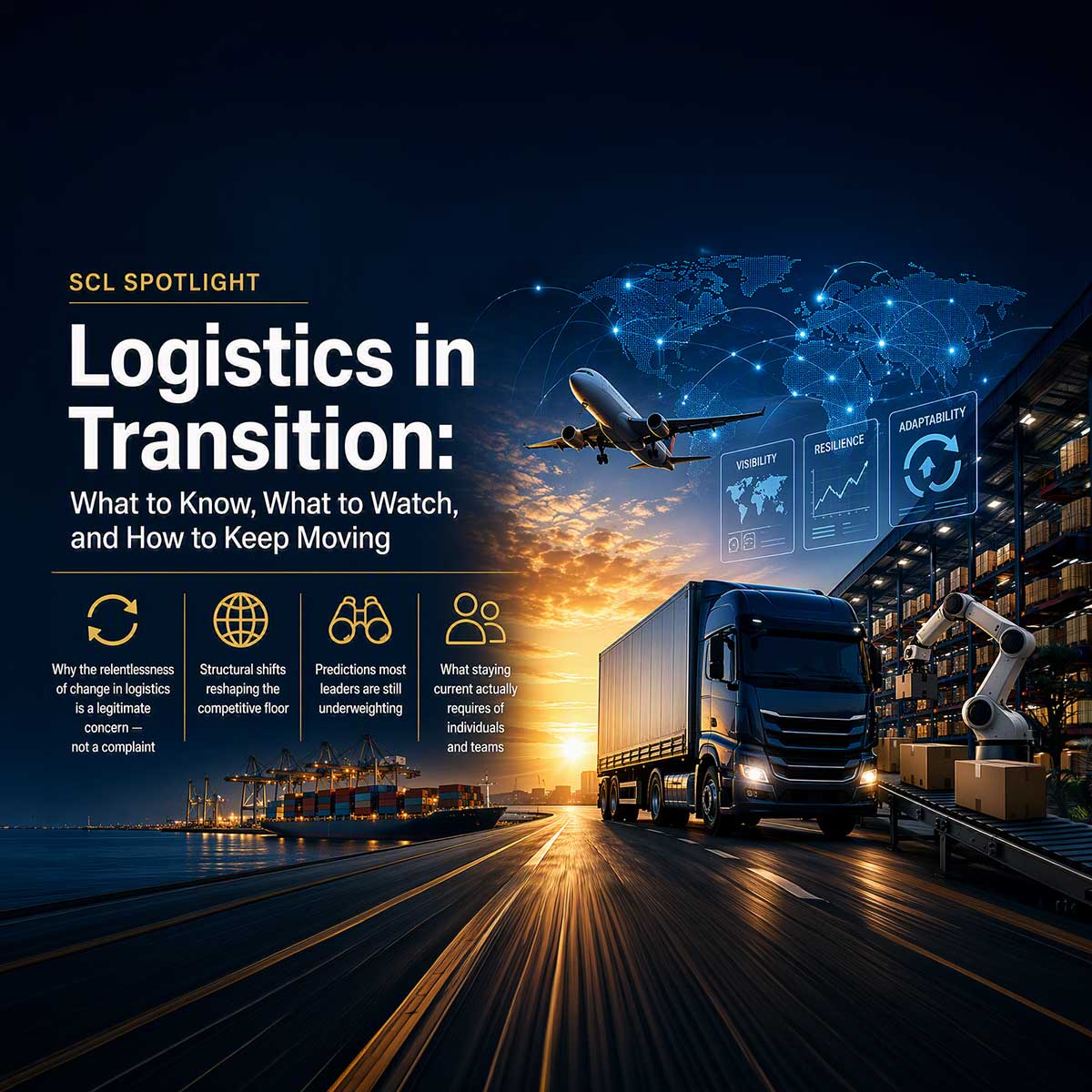
- Why the relentlessness of change in logistics is a legitimate concern — not a complaint
- Structural shifts reshaping the competitive floor
- Predictions most leaders are still underweighting
- What staying current actually requires of individuals and teams
The Weight of Constant Curveballs
A few months ago, I caught up with a former colleague at an industry event. He is a senior leader at a large global company with a well-regarded supply chain organization. His team had been through a lot since we last talked. Port closures. Tariff escalations. Freight volatility. Inventory repositioning. The kinds of disruptions that used to arrive once in a cycle had become an avalanche, and this was before Hormuz!
His people had responded well. They had adapted. But now he was thinking about something harder to solve: what it would take to keep them in the game longer term. The experience his team had gained came at a cost and he worried some would look for roles that were not on the “firing line”. He also wondered whether he could still attract the best and brightest in the next generation of talent who would be looking at this field and asking whether the complexity was worth it.
That conversation has stayed with me. Supply chain and logistics has always been a field of cycles — demanding, but navigable. What has changed is that the field has moved from cyclical difficulty to something more structural: a persistent state of volatility where the curveballs do not stop coming.
That conversation was in the back of my mind as I developed a recent talk on logistics trends from 2026 to 2030 for GT SCL Industry Partner Manhattan’s annual Momentum conference. The brief was to look ahead and be a bit provocative. What follows builds on that talk, but with a broader point in view: if the curveballs keep coming, leaders need a clearer sense of which shifts matter most and what they should do about them.
The New Operating Environment
Logistics has entered a structurally more volatile era, not a groundbreaking insight given the last four years. Several things changed at roughly the same time, and they have not changed back:
Several shifts hit the industry at once, and none of them have meaningfully reversed. Geopolitics is now a supply chain design variable, not something to catch up on in a podcast. Strategic decoupling between China and the United States, instability in the Middle East, and the long shadow of the Russia-Ukraine conflict have pushed energy, sourcing, and network design into the same conversation. What once sat in the news feed now needs to be in the nominal scenario during business planning.
At the same time, customer expectations have permanently shifted. Amazon reset the standard for visibility, precision, and speed, and that standard now applies even more as Amazon is emerging as an open source 3PL. Labor and energy costs have also changed the economics of physical logistics in ways that will not self-correct. Demographic pressure, wage inflation, and energy volatility have altered the baseline cost structure calling into question existing network locations.
Meanwhile, AI and automation have moved out of the experimental category and into the realm of near-term value creation. The tools are real, and organizations that understand where to apply them are making materially better decisions than those that do not. That matters because networks now have to optimize for two things at once: cost and recovery. Efficiency still matters, but a network that performs well in steady state and fails under disruption no longer meets the standard.
There is also a macro pattern worth calling out: the industry is in a longer-duration rebalancing cycle than many executives expected. We examined the Hormuz disruption and its downstream effects in a recent SCL Spotlight piece. The short version is that energy pass-through effects, freight volatility, and extended planning uncertainty will impact costs and capacity well into 2027. Executives planning around a near-term return to normal are making a strategic error.
The next decade will reward adaptable logistics networks more than simply optimized ones.
The Benchmark Has Changed — For Everyone
Amazon's logistics operation is not just something to amaze us as packages arrive at our doorstep consistently with compressed lead times. It is a capability demonstration that has redefined what customers consider normal — same-day expectations, ETA precision, real-time visibility, low-friction returns. The important implication is not that every organization needs to replicate Amazon's infrastructure. It is that Amazon-shaped expectations are now the standard against which every supply chain is measured, whether or not Amazon is a direct competitor. Amazon’s recent announcement that it is making its capabilities available to all only raises the bar.
Organizations that understand this have shifted their strategic question from "how do we improve our operations" to "where will we compete, where will we leverage others' capabilities, and where will we differentiate on something Amazon cannot replicate." The benchmark is no longer functional excellence alone. It is well oiled end-to-end execution.
The Real Automation Story: Error-Proofing Over Spectacle
There is a version of the automation conversation that focuses on “wow” demos — autonomous vehicles, lights-out warehouses, robotics showcases. That version makes for compelling conference content. It is also not where most of the real value is being created today.
The highest-value wins tend to be quieter: fewer errors, fewer touches, fewer injuries, fewer claims. Computer vision that catches a loading error before a truck leaves the dock. Sensor verification that eliminates a reconciliation step. An alert from a Machine Learning model that prevents a cascading service failure. These are error-proofing stories, and they are compelling because the ROI is measurable in terms operations leaders understand.
The reason automation is scaling in these areas is not novelty — it is because the math finally works, driven by labor scarcity, safety pressure, and the compounding cost of variability. My own view informed by industry contacts and academic researchers is that computer vision may become one of the most quietly transformative technologies of this decade, not because it is the most advanced, but because it applies to so many high-variability, human-intensive touchpoints across logistics operations.
That said, a high percentage of large-scale automation efforts still fail. Many of the reasons are well known and tackling this issue is critical for those who do not yet have a model for success.
The next margin pool may come more from consistency and reliability than from flashy robotics demonstrations.
This theme generated significant discussion at the Manhattan Associates' Momentum conference this spring — enough that we are dedicating our July SCL webinar to it directly. If your organization is navigating automation decisions, the session is worth your time.
Autonomy: Watch the Middle Mile Before the Long Haul
Autonomous vehicle technology has generated significant hype and its share of missed timelines. A more realistic view is emerging. Autonomy scales first where variability is lowest, economics are clearest, and environments are most constrained — yard operations, middle-mile freight on repetitive lanes, internal shuttles, port drayage, and warehouse orchestration. This amounts to millions of miles and load counts that are increasing daily.
The organizations watching this most carefully are not asking when full autonomy will arrive. They are asking which specific lanes and operations have the cost structure where autonomy pays out today. One dynamic worth watching: the scaling of urban robotaxi operations is building safety data, insurance frameworks, and regulatory precedent that may indirectly accelerate confidence in middle-mile freight and warehouse applications.
The shift that matters is not from no autonomy to full autonomy. It is from technology demonstrations to lane economics — and that is the transition that creates real operating decisions for logistics leaders.
AI Is Real — But Workflow Discipline Matters More Than Tool Selection
The common reality in most logistics organizations today includes AI copilots, workflow assistance tools, exception management support, improved ETA prediction, and document automation. These are useful. They are also early.
What is still uncommon: autonomous execution, fully integrated AI decisioning across functions, self-optimizing networks, and end-to-end agentic orchestration. Those capabilities exist in pilots and in forward-leaning early adopters. They are not yet standard operating practice in most organizations.
The framing that I keep coming back to is this: start with a broken logistics workflow, then apply the lightest AI capable of clearing a hard ROI threshold. I got a text from a mentee today that showed a picture of a Microsoft Co-pilot Studio agent he built that automates a daily inventory check on a critical SKU. Organizations that start by selecting the most impressive tool and then look for a process to apply it to are making the investment in the wrong order.
There is another structural shift worth highlighting. The industry has moved out of data scarcity and is living in decision overload. The challenge is not access to information — it is building the discipline to convert that information into insight and informed decisions at the right time to impact action.
Logistics first, AI second. Start with the broken workflow. Then apply the lightest tool that clears a hard ROI threshold.
The Rising Value of Human Judgment
Back to the conversation I opened with. The concern was not that my friend’s team lacked technical skills — it was sustaining engagement and attracting talent to a field that had become genuinely exhausting. That challenge is real, and it is connected to something missed in the automation conversation.
As AI automates more routine work — reporting, documentation, tracking, reconciliation — the work that remains becomes more demanding in different ways. The value shifts toward judgment: escalation management, cross-functional orchestration, interpreting second-order consequences, maintaining trust when the data is ambiguous. The organizations that will attract and retain the strongest professionals are not necessarily those with the most advanced tools. They are the ones that create conditions where smart people make consequential decisions and continue to grow.
As AI capabilities become more democratized across the industry, the differentiating capabilities will increasingly be leadership, communication, collaboration, and the kind of critical thinking that no tool can fully replicate.
Predictions Leaders Should Keep an Eye On
These are the shifts I believe deserve more attention than they are getting in most leadership conversations:
- The Next Major Logistics Disruption May Come From Energy, Not Freight
Grid strain, electrification demand, AI compute infrastructure buildout, and charging capacity constraints are converging in ways that could reshape logistics economics faster than expected. Power availability is not yet a front-burner strategic issue for most logistics leaders. It should be.
- Amazon, Walmart, and Chinese Platforms May Become Competing Logistics Operating Systems
Competition is shifting from retailer vs. retailer to ecosystem vs. ecosystem. The organizations that do not think clearly about which ecosystems they are part of, and on what terms, may find themselves structurally disadvantaged.
- Cyber Attacks on Physical Supply Chains Will Become a Defining Executive Risk
As logistics networks become more connected, more automated, and more AI-dependent, your exposure grows. The distinction between cyber risk and operational risk is collapsing. This belongs on the executive agenda as a strategic issue, not just an IT issue.
- Trusted Operational Data May Become the Most Valuable Logistics Asset
Organizations with clean, well-governed operational data will be able to move fast on AI adoption. Organizations with fragmented, inconsistent data will face a structural disadvantage that no AI investment can overcome. Data discipline is a strategic investment, not a cleanup project.
- Insurance Companies May Quietly Become Gatekeepers of Automation Adoption
Scaling autonomy and connected logistics infrastructure depends as much on insurability, liability frameworks, and safety validation as on technical capability. Insurance market dynamics will shape the adoption curve for autonomous operations in ways that are not yet widely discussed in logistics circles.
- The Industry May Shift From "Lowest Cost" to "Fastest Recovery" as the Defining Competitive Dimension
Pure cost optimization as a primary network design principle may increasingly underperform against resilience and recovery speed as the basis of competition. The organizations that have already internalized this are building different networks than those still optimizing for cost alone.
What Staying Current Actually Requires
I want to close by coming back to my colleague's concern — and to the question he was really asking: how do we help our people process all of this and remain effective?
Here is my honest answer. The field is not going to slow down. What staying current requires is not reading every article or attending every conference. It requires developing a point of view on the shifts that matter most for your specific context, and then actively deciding how you will act and adjust. Passive awareness is not enough. The question is not whether you know what is changing. It is what you have decided to do about it.
For organizations, that means investing in conditions that allow talented people to keep learning. For individuals, it means resisting the temptation to treat busyness as a substitute for development. The professionals who remain most valuable will be those who continue to understand what is changing and develop the judgment to translate that understanding into better decisions.
You cannot sit still. The question is not whether you know what is changing. It is what you have decided to do about it.
The Opportunity on the Other Side
I want to end where I began — with empathy for everyone in this field who is carrying a lot right now. Fatigue is real. The complexity is real. The ongoing intensity is real.
And so is the opportunity.
Logistics is no longer just moving product. It is becoming a resilience system, a customer experience system, a technology system, an energy system, and a real-time decision system simultaneously. The professionals who learn to navigate that complexity — who develop both technical fluency and human judgment — will be among the most valuable people in any organization.
The future arrives not as one dramatic breakthrough, but as a sequence of operational readthroughs: decisions made well, workflows redesigned thoughtfully, capabilities built deliberately. That is hard work. It is also genuinely exciting work. And I believe the best of it is still ahead.
Related Upcoming SCL Webinar 7/2/2026
Why Do So Many Automation Projects Fail?
Automation in logistics is accelerating — but so is the gap between what is promised and what is delivered. Systems get sized on optimistic assumptions. Hidden dependencies become single points of failure. Technology that shines in the demo struggles under real operating conditions.
Leaders from Georgia Tech's Supply Chain and Logistics Institute join industry practitioners to dig into the root causes of automation underperformance — and the design, evaluation, and implementation practices that build more resilient, effective operations.
Register Online to attend via Zoom
Can't attend live? Register anyway, and we'll send you the recording afterward
Logistics in Transition

Chris Gaffney