
By Chris Gaffney, Managing Director of the Georgia Tech Supply Chain and Logistics Institute, Supply Chain Advisor, and former executive at Frito‑Lay, AJC International, and Coca‑Cola
We recently wrapped our semi‑annual industry advisory board meeting, where a core element of the agenda is a set of "hot topics" sourced in advance from our member companies, curated, and facilitated to reflect what is most top of mind in the field. This cycle, one of those topics focused on the impact of AI on supply chain technology investment.
What began as a discussion on technology quickly surfaced a broader issue:
AI is not just changing supply chains—it is raising the standard for execution, and in doing so, redefining what it takes to sustain a brand.
When Capability Becomes Cheap
Within that discussion, a simple example sparked debate. Most of us would trust a platform like DocuSign without hesitation. It has earned that trust through reliability, security, and consistent performance.
But what if a new entrant—call it “FredSign”—offered similar functionality, powered by AI, at lower cost and with comparable features? Would you use it?
The room split. Some argued that established brands are durable because of the trust they have built over time. Others pushed back, suggesting that AI‑enabled challengers could close that gap faster than expected, making brand less relevant.
The discussion quickly moved beyond software to a broader question:
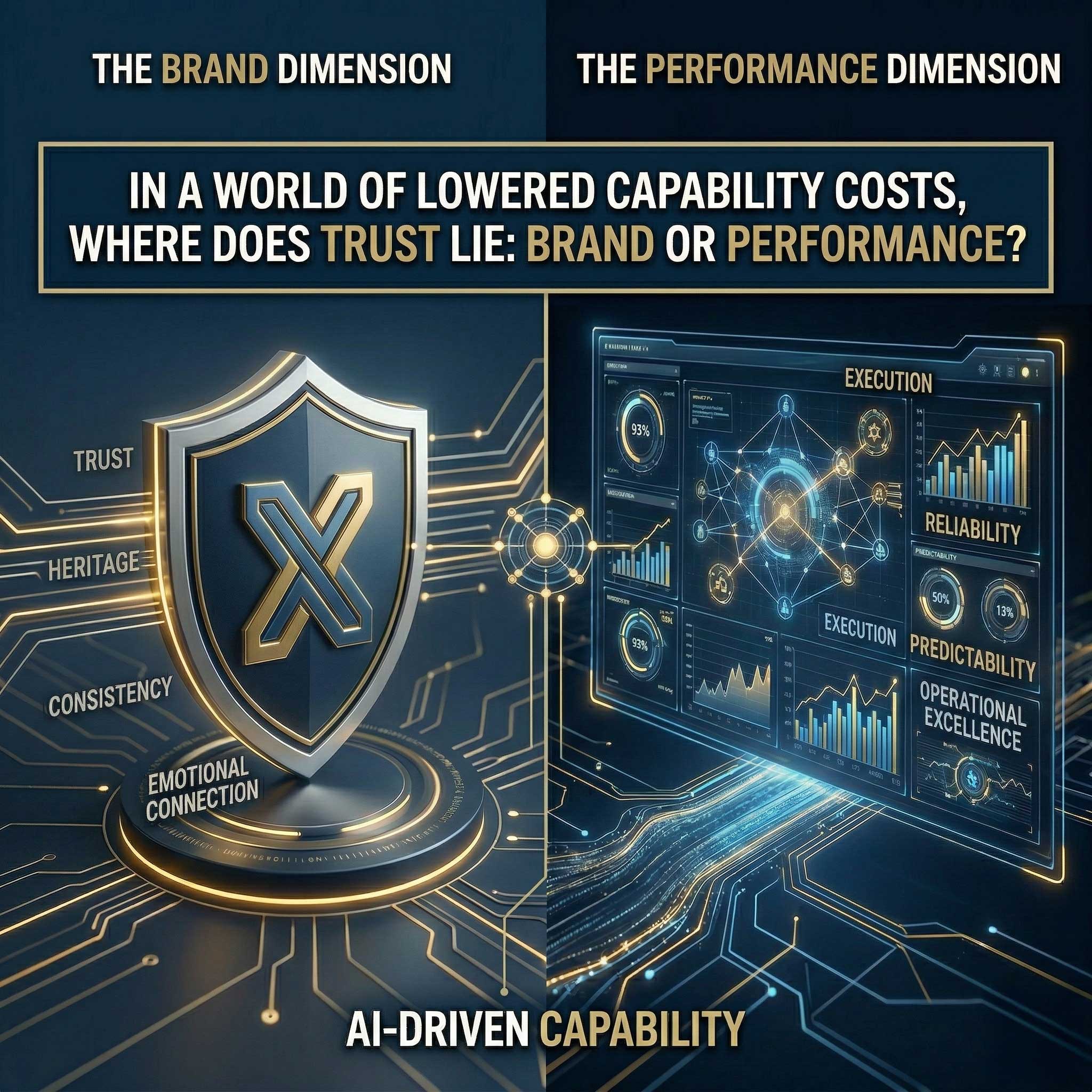
In a world where AI lowers the cost of building capability, does trust shift from brand to performance—or does brand become even more important?
Brand as a Promise
From a supply chain perspective, this is no longer theoretical. It is already happening.
At its core, a brand is a promise. For product companies, that promise is built on quality, consistency, and the experience of using the product over time. For supply chain technology and service providers, it is grounded in reliability, security, and confidence in execution.
Historically, brand has been reinforced by performance—but also protected by time, scale, and familiarity.
AI is changing that balance.
Lower Barriers, Higher Expectations
On one hand, AI lowers barriers to entry. New entrants can replicate functionality faster, improve user experiences, and target specific gaps in incumbent offerings.
In supply chain technology, this is particularly relevant. Many organizations have made significant, long‑term investments in systems that have not always delivered as expected. That creates an opening for AI‑enabled providers to enter through narrow use cases, solve specific problems better, and establish a foothold. Over time, they build credibility.
But there is a second dimension that is more immediate—and more consequential.
AI Raises the Execution Standard
One way to frame this is simple: data is a terrible thing to waste.
For years, supply chains have generated vast amounts of data across planning systems, transportation networks, warehouses, and customer interactions. Much of that data has been underutilized—captured, stored, but not fully leveraged to anticipate risk or improve outcomes.
That is changing.
The capability now exists—and is rapidly maturing—to sense, interpret, and act on that data in ways that were not previously practical. Risks can be identified earlier. Disruptions can be predicted. Corrective actions can be taken before the customer ever feels the impact.
From Disruption to Preventability
Over the past week, in the span of just six days and four unrelated conversations with members of my network, I heard a series of examples that all pointed to this shift.
- A global food company managing risk tied to a critical supplier whose quality issues could impact multiple major brands—raising the question of whether AI could have surfaced a near sole‑source dependency earlier.
- An e‑commerce retailer using machine learning to reduce theft and damage in its fulfillment network, improving the customer experience.
- An organization proactively shifting its fulfillment partner mix based on AI‑driven insights into which nodes can and cannot handle surge capacity.
- A high‑end clothing shipment arriving wet due to a fulfillment breakdown—where the loss was not just the product, but a time‑sensitive moment that could not be recovered.
- A consumer receiving an empty box after successfully purchasing a limited‑release product that could not be replaced.
These are not isolated anecdotes. The common thread is not disruption—it is preventability.
As AI enables earlier detection of risk, better prediction of disruptions, and faster response to exceptions, the tolerance for failure is declining. Companies are no longer judged simply on whether something went wrong. They are judged on whether it should have been avoided.
Brand Is the Delivered Experience
From a brand perspective, that is a fundamental shift.
A product brand may invest heavily in innovation and customer engagement. But if the product arrives damaged, late, or not at all, the customer does not distinguish between the brand owner and the supply chain behind it.
There is only one experience—and therefore only one brand.
In an AI‑enabled supply chain, failure is no longer just a risk—it is increasingly a choice.
The Weakest Node Defines the Brand
A brand is now only as strong as its weakest node.
That node may be a supplier, a logistics provider, a fulfillment partner, or a technology platform. Many sit outside the direct control of the brand owner, yet their performance is inseparable from the customer’s perception of the brand.
AI makes it possible to identify and address these weak points—but it also makes it more apparent when companies fail to do so.
Implications for the Supply Chain Ecosystem
This dynamic extends directly to platform and software providers. In an AI‑enabled environment, it is no longer sufficient for supply chain technology to be stable or functionally adequate. It must evolve—continuously—to sense risk earlier, enable better decisions, and improve execution outcomes. If it does not, its limitations will be exposed quickly, and alternatives will emerge.
Technology providers are not insulated by their brand; they are judged by the outcomes they enable. Their brand will strengthen if their platforms improve execution—and erode if they do not.
Product companies must use AI to protect the customer experience end‑to‑end. Logistics providers must adopt AI to remain credible partners. Technology providers must evolve their platforms to meet a higher execution standard.
If one part of the system advances while another does not, the gap will be visible—and acted upon quickly.
Winners and losers are being judged daily.
What This Means for Leaders
None of this suggests that brand is no longer important. In high‑trust, high‑risk environments—contracts, financial transactions, healthcare, and other sensitive use cases—brand remains critical.
Even in this environment, trust must be continuously reinforced through performance. Leaders must clearly understand what underpins their brand. Brand is not an asset to be protected; it is the result of consistently delivering on a promise. Any performance gaps must be addressed before others move in. AI‑enabled challengers will not challenge strengths—they will target weaknesses.
Finally, leaders must elevate their ecosystem. Brand performance is now inseparable from partner performance. That requires greater visibility, tighter integration, and higher expectations—not only internally, but across suppliers, logistics providers, and technology partners.
One Question to Answer Now
This execution dimension is only one part of how AI is reshaping brand—but it is already decisive.
A great product can still win. A strong brand can still endure. But in an AI‑driven world, where disruptions can be anticipated and failures mitigated, the margin for error is disappearing.
And in many cases—especially where the purchase is infrequent or the moment is critical—you only get one shot. At the conclusion of our discussion, one participant framed it simply:
What is our secret sauce—and what are we doing to build on it?
That is the question every supply chain leader should be answering now.
Because in an AI‑enabled world, your brand will be defined by what your system consistently delivers.
The Future of Brand in an AI-Driven World: A Supply Chain Perspective

Chris Gaffney