
Title:
Optimization Meets Participation: Iterative School Zone Generation with LLMs
Abstract:
In U.S. public school systems, geographic boundaries play a central role in shaping students’ assignments and access to opportunity. For example, the San Francisco Unified School District (SFUSD) recently adopted multi-school zones with controlled choice to jointly promote diversity and proximity to assigned schools. Designing such zones is both computationally and socially complex: algorithmic approaches are required to balance competing objectives at scale, yet stakeholders are typically asked to articulate their preferences upfront, before seeing feasible zone maps, limiting their ability to meaningfully influence outcomes. We propose a stakeholder-in-the-loop framework for joint preference elicitation and zone design. Our approach iterates between using optimization to generate zones and collecting participatory feedback as stakeholders react to zones. To enable broad participation, we use large language models (LLMs) to translate between natural language stakeholder input and optimization constraints. To support real-time iteration, we develop faster computational methods for the multi-school zoning problem, using both mathematical programming and sampling-based approaches. Our framework produces zones with substantially improved diversity and proximity metrics relative to existing benchmarks, while also generating individual-level preference representations that can be aggregated using standard social choice methods. Our approach has been used to support preliminary discussions about zone boundaries in SFUSD and are generalizable to other redistricting and participatory planning contexts.
Bio:
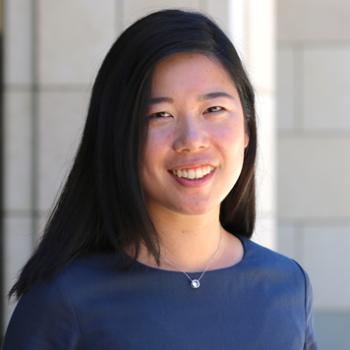
Irene Lo is an assistant professor in the department of Management Science & Engineering at Stanford University. Her research sits at the intersection of operations research, computer science theory, and economic theory. She designs markets and allocation systems that improve both efficiency and equity, with applications in education, the environment, and the developing world. She leads a Stanford Impact Lab on Equitable Access to Education, co-launched the ACM Conference series on Equity and Access in Algorithms, Mechanisms, and Optimization (EAAMO), and is a William T. Grant Scholar.